ICE Panels and traditional stick-frame construction are two popular methods, but they differ significantly in a few ways. Let’s break down the key differences to help you decide which is the better option for your next project.
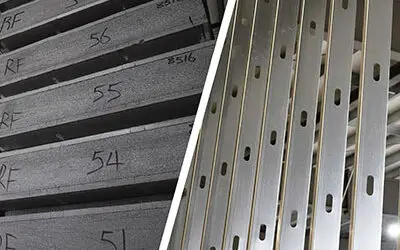
To achieve an R36 wall with ICE Panels, all you need is our 7.5″ ICE Panel, polyurethane foam to fill any gaps, and a 3M membrane to seal the joints. That’s it – simple and straightforward.
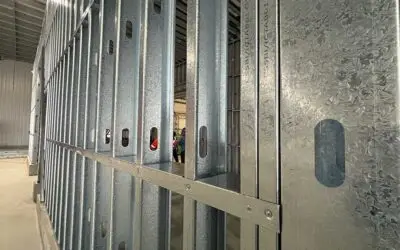
Whereas achieving the same R36 with stick-frame construction would require a 10.5″ wall and a more complex assembly process. You’ll need double 2″ x 4″ walls, a 3.5″ gap, two layers of fiberglass insulation, exterior sheeting, and interior poly. ICE Panels streamline the process into a single-step assembly, while stick-frame construction involves multiple steps to reach the same result.
Energy efficiency is another area where ICE Panels stand out. ICE Panels are thermally broken, meaning they prevent heat transfer through the wall. They feature a solid EPS core with double steel framing, no penetrations, and R-values that can reach R55.
On the other hand, stick-frame construction has thermal bridges at every stud, allowing hot and cold air to transfer through the wall. This makes stick-frame walls less energy-efficient compared to ICE Panels.
ICE Panels combine framing, insulation, and a vapor barrier into a single step. This integration simplifies the construction process and reduces the time and labor required. Stick-frame construction, by comparison, only addresses the framing in the initial step, leaving insulation and vapor barriers as separate tasks. While stick-frame might seem faster at first glance, it only completes one part of the process, whereas ICE Panels complete three.
With ICE Panels, you would only need one crew to assemble the envelope, whereas with traditional stick frame construction, it often requires multiple crews.
If you’re looking for a smarter, more efficient way to build, ICE Panels are the clear choice. To learn more about ICE Panels email info@gsbp.ca.